

Editor’s Note
Welcome to the first edition of What’s the Material? — a new series where we take a closer look at some of the city’s most popular architectural projects and catalog their exterior finishes. It’s remarkable how familiar we are with these buildings, yet how hard it can be to track down the materials that make them unique. This series aims to solve that problem and give you an inside look at the elements that define each project. We hope you enjoy exploring it as much as we enjoyed putting it together.
The Calgary Central Library is often recognized for its striking crystalline form, but the real story sits in how a series of very different materials were coordinated into a single, highly controlled system. What looks expressive on the outside is tightly engineered underneath.
Help us grow. We are building a community of architects and designers focused on smarter material selection. Share this with someone who would benefit.
RECKLI
Precast Concrete
The project begins at ground level with precast concrete that establishes the building’s base. Approximately 171 precast elements were produced locally using elastic formliners to achieve a wood grain texture. Apparently, during fabrication, a minor process decision introduced an issue during casting. Silicone was used as a barrier in conjunction with the formliners, but it left behind a residue that transferred onto the concrete surface. The effect was subtle but enough to impact the finish. The affected liners were replaced and production resumed without the use of silicone. No further issues were reported. In total, roughly 1,400 square meters of textured precast wraps the lower portion of the building, creating a distinct base condition relative to the more geometric façade above.


Something like this.
ALPOLIC MCM
Aluminum Composite Panels
Above that base, the building shifts into a completely different system. The façade becomes a unitized assembly of glass and metal arranged into a repeating hexagonal pattern that wraps continuously around the structure. There is no true front or back elevation. The geometry reads as consistent from every angle, which is part of what gives the building its object-like quality in the city.
The metal portion of this system is primarily composed of aluminum composite panels, specifically ALPOLIC MCM. More than 110,000 square feet of these panels were used, finished in custom white prismatic coatings that subtly shift in changing light conditions. The choice of a lightweight composite panel is not just aesthetic. It allows the façade to handle complex geometry without introducing excessive structural load, which becomes critical on a building that is already spanning over active infrastructure. The finish itself is based on a high-performance FEVE coating, selected for long-term color stability and durability under UV exposure.


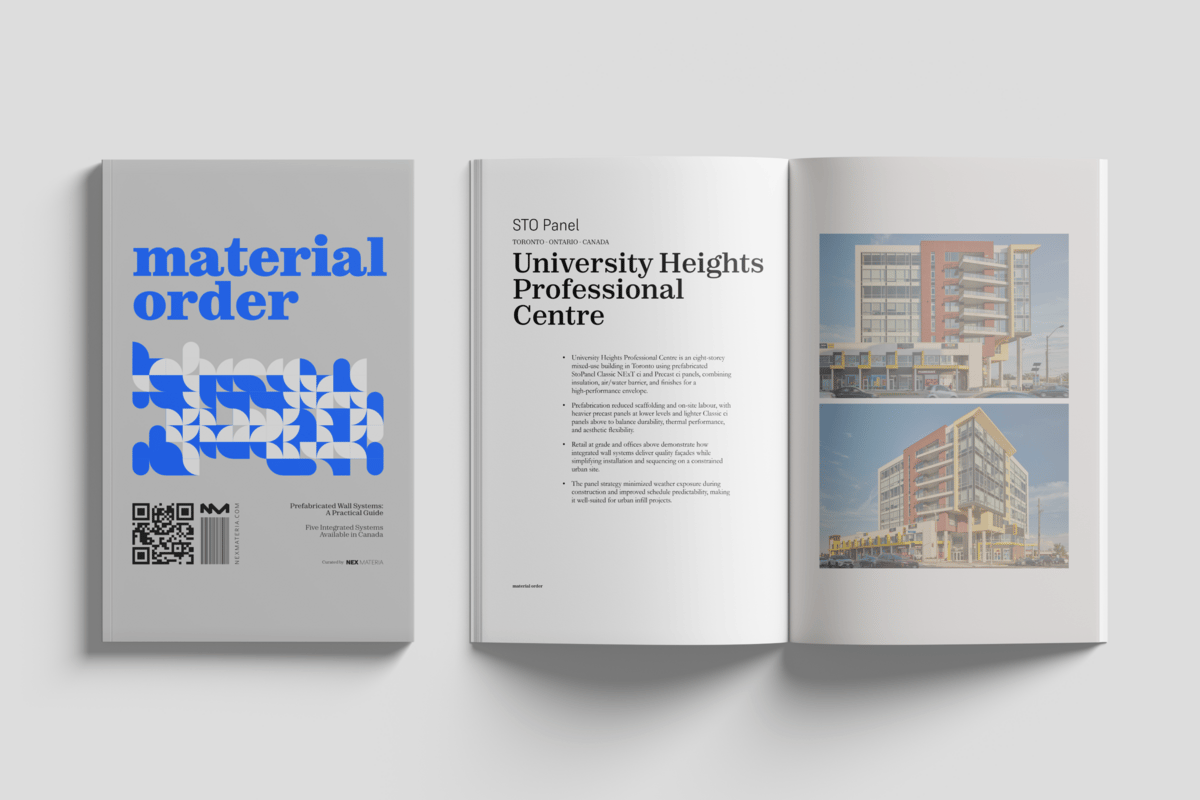
If you missed it, our Guide to Prefabricated Wall Systems in Canada is free to download here!
VITRO
Architectural Glass
Integrated within this system is a high-performance glazing assembly using products from Vitro Architectural Glass. The units combine Solarban 60 and Solarban 72 coatings with Starphire ultra-clear glass in a triple-pane configuration. This layering is doing more than providing transparency. It is carefully balancing solar heat gain, visible light transmission, and clarity. The result is a façade that appears bright and open from the interior while still meeting energy performance targets required for LEED Gold certification.

What makes this façade particularly demanding is not the individual materials, but the lack of repetition. While the pattern appears regular at a distance, the panel shapes and connections vary across the surface. Each transition between glass and metal requires tight coordination between fabrication and installation.
Small dimensional tolerances can accumulate quickly, and in a system like this, misalignment does not stay isolated. It propagates. That is the hidden challenge behind expressive geometry. The visual simplicity is achieved through a high degree of control during manufacturing and sequencing on site.
The Structure Behind the Form
All of this sits on top of a structural system that is doing the heaviest lifting, both literally and conceptually. The building spans over an active light rail line, which required a series of large steel trusses to transfer loads without interrupting the transit corridor below. That constraint drives much of the project’s logic. The façade, while visually dominant, is ultimately responding to decisions made at the structural level.
Taken together, the Calgary Central Library is less about any single material and more about coordination. Precast concrete introduces texture and scale at the base. Composite metal panels and high-performance glazing define the building’s identity above. The structure enables the entire composition to exist where it does. The success of the project comes from how precisely these systems were resolved against one another, not just how they look in isolation.

From the Architect’s Desk
“The function of design is letting design function.”
– Micha Commeren
Until next time,

Bibliography
RECKLI. Central Library Calgary, Canada – Project Reference.
https://www.reckli.com/references/detail/central-library-calgary-canada/
Lafarge Canada (Calgary Precast Division). Precast concrete production for Calgary Central Library façade elements.
(Referenced via RECKLI project documentation)
Vitro Architectural Glass. Calgary Central Library Project Case Study.
https://projects.vitroglazings.com/calgary-central-library
ALPOLIC. ALPOLIC MCM Helps Create a New Landmark in Calgary.
https://alpolic-americas.com/blog/alpolic-mcm-helps-create-a-new-landmark-in-calgary/
Snøhetta and DIALOG. Calgary Central Library – Project Authors.
(General project attribution and design context)
